

Product Description
Knowing how low your microbiome assay can see matters as much as knowing what it sees. This log-distributed mock community from Zymo Research spreads ten organisms across many orders of magnitude, making it easy to determine the detection limit of an entire sequencing workflow from extraction through analysis.
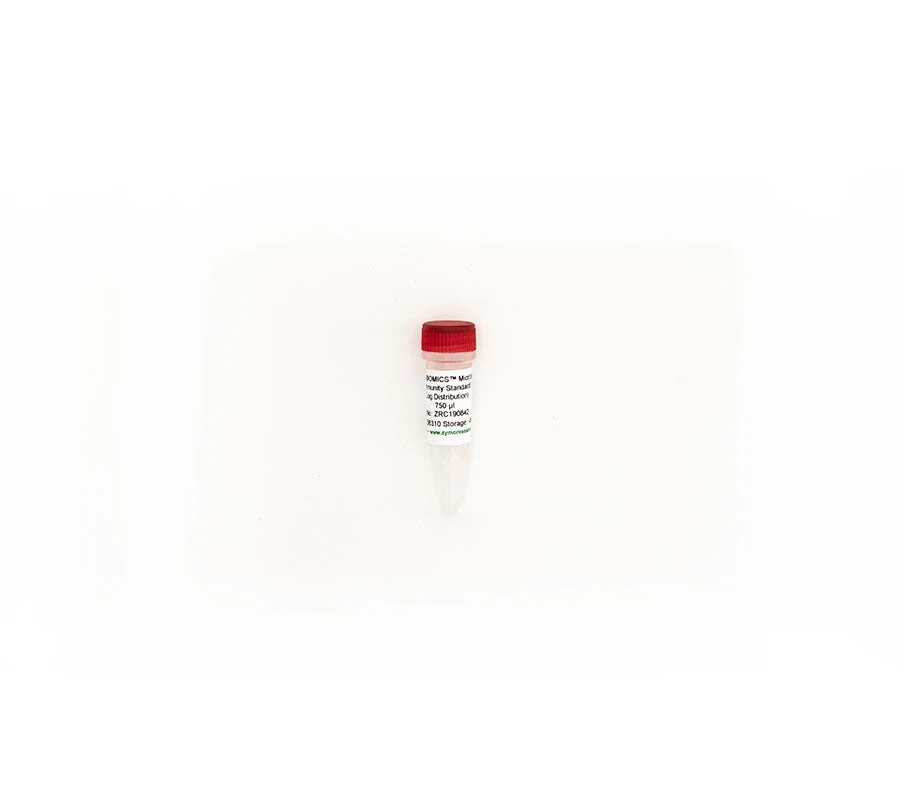
This listing is for catalog number D6310: ZymoBIOMICS Microbial Community Standard II (Log Distribution), 750 µl. The standard contains whole cells of eight bacteria and two fungi mixed at logarithmically stepped abundances. In 75 µl, the rarest organism, Staphylococcus aureus, is present at roughly 100 cells. It can be run on its own as a positive control or spiked into a matrix such as soil or blood to mimic real study samples. Each tube supplies 750 µl. LIGHT LABS stocks the Zymo Research line, so kits, buffers and refills are always within reach.
Key Features
- Log-distributed abundances – Organisms range from 89.1% down to 0.000089% of genomic DNA.
- Detection limit testing – Reveals the lowest abundance your workflow reliably detects.
- Whole-cell format – Challenges the full workflow beginning at lysis.
- Matrix spike-in – Can be added to soil, blood or other matrices to simulate real samples.
- Bacteria and fungi – Includes eight bacterial and two fungal strains.
Specifications
| Catalog Number | D6310 |
| Brand | Zymo Research |
| Description | ZymoBIOMICS Microbial Community Standard II (Log Distribution), 750 µl |
| Format | Cellular mock community |
| Volume | 750 µl |
| Organisms | 8 bacteria and 2 fungi |
| Lowest abundance | About 100 S. aureus cells per 75 µl |
| Theoretical composition (gDNA) | L. monocytogenes 89.1%, P. aeruginosa 8.9%, B. subtilis 0.89%, S. cerevisiae 0.89%, E. coli 0.089%, S. enterica 0.089%, L. fermentum 0.0089%, E. faecalis 0.00089%, C. neoformans 0.00089%, S. aureus 0.000089% |
| Shipping Conditions | Ships at room temperature |
| Storage | -80°C |
Applications
- Microbiome assay sensitivity testing
- Sequencing workflow validation
- Low-abundance pathogen detection studies
- Spike-in matrix experiments
- Routine sequencing positive control